
WHY IT MATTERS
A STORY LARGE ENOUGH TO LIVE FOR
Why a generation needs purpose—and why generations need one another

A young person can carry the world’s information in a pocket and still wonder where, within that world, he or she belongs. Beneath the speed of cultural change lies a quieter hunger for a story large enough to give life direction.
Younger generations are surrounded by information but increasingly starved for transcendence, belonging, purpose, and hope. Beneath the noise are ancient questions:
Who am I? Where do I belong? What story am I living in?
What is worth loving? What is worth giving my life for? Where is history going?
We can prepare a young person for a career, teach useful skills, open doors and place extraordinary technology within reach. Yet beneath those opportunities remains a question success alone cannot answer: what is this life for? Without somewhere to carry that question, even accomplishment can leave a person strangely empty.
WE ALL LIVE INSIDE A STORY
Every generation receives a story. It tells us where we came from, who we are, what is good, what has gone wrong, what is worth protecting, and where we are going.
For generations, much of that story passed quietly from one life to another—around tables, on farms and factory floors, in churches and workshops, through songs and Scripture, through stories grandparents told because they remembered what their grandchildren had never seen.
The generations before us carried failures alongside their faithfulness. Yet through many of their ordinary acts of care, they gave us a place inside a story larger than ourselves.
Today, we have extraordinary freedom to construct our own lives. But that freedom carries another burden: Find your identity. Create your meaning. Choose your truth. Build your life. Become yourself.
The promise of such freedom can be exhilarating, until the whole weight of identity and meaning rests upon a person who is still searching for somewhere to stand.
We do not write our own story. We enter a Story already in progress.
THE STORY WE ARE TRYING TO REMEMBER
The Christian Story brings us to a beginning earlier than achievement, before we had anything to prove or offer. Our first breath was received within a creation called into being by love.
We were created in love and for relationship—with God and with one another.
Within that Story, what is beautiful can be wounded without being abandoned. Our dignity survives the loss of usefulness, and love makes claims upon our freedom. Because suffering does not have the final word, forgiveness can open a future where estrangement once seemed permanent.
And history is not wandering toward nowhere. It is going Home.
At the center of that Story stands Jesus Christ—not merely an idea about God, but God entering the human story, close enough to see, hear, touch, follow, reject, crucify, and love.
The Christian claim is not simply that Jesus gives us better principles for constructing our lives. He is the Way Home.
Such a Story gives us something worth living for, and a light by which a generation may begin to find its way through the fog.
HOW A STORY BECOMES A LIFE
Truth and theology give essential shape to our understanding, yet the truths that form a life must also reach its longings, habits and relationships.
We are creatures of longing, memory, attachment, beauty, relationship, and love. Before a vision of life becomes intellectually compelling, it must often become imaginatively plausible.
Sometimes a story lets us recognize a longing before we know how to name it. We hear the Song, feel its weight, and discover that something within us has been waiting for its sound.
IMAGINATION → REFLECTION → CONVERSATION → RELATIONSHIP → FORMATION → GENERATIONAL RENEWAL
Art awakens the imagination. Imagination prompts reflection. Reflection invites conversation. Conversation deepens relationship. Relationship creates the context for formation. And formation, faithfully carried from one generation to another, makes generational renewal possible.
IT BECOMES PERSONAL AT THE TABLE
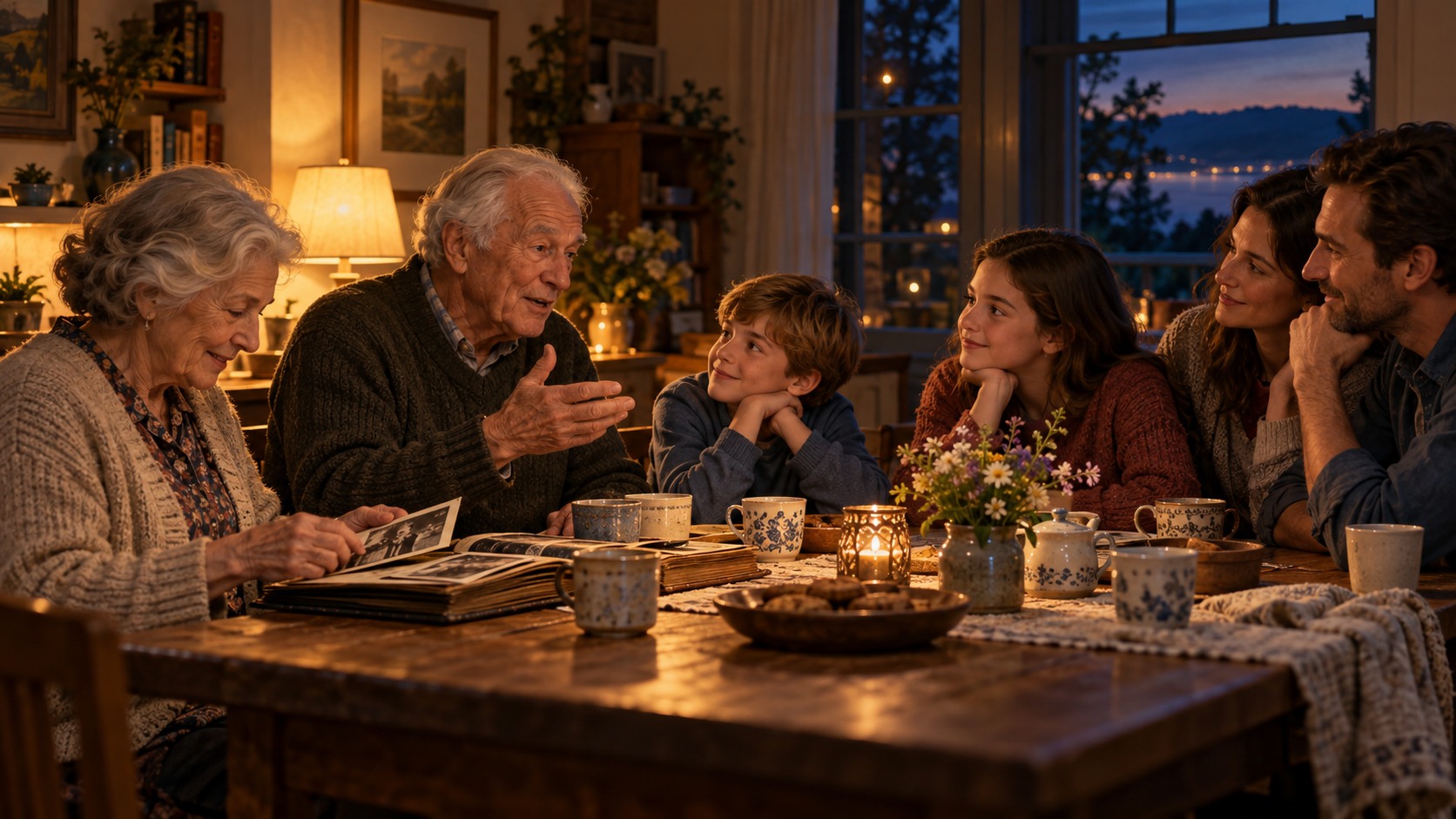
The hope of cultural renewal can feel far beyond our reach. Around a table, however, its beginnings may be close enough to hear.
A grandfather begins a story, and a grandmother supplies the name he has forgotten. A daughter asks a question that makes the room grow attentive; a father finds words for something he should have told his son years before. In the same conversation, a parent may find the courage to acknowledge what the family got wrong.
A young person begins to understand that the generations before her were imperfect—but perhaps more right about some things than she once believed.
As people listen and remember, there may be room for forgiveness—and for someone younger to receive the story with a new understanding of those who carried it.
This is where memory becomes inheritance and story becomes formation.
We do not honor those who came before us by pretending they were perfect. We honor them by receiving what was true and good, learning from what was broken, and carrying the best of their inheritance farther.
The young remind us the story is not finished.
The old remind us it did not begin with us.
A SONG FOR THE GENERATIONS
This is why we are creating A Song for the Generations.
Through original songs, companion stories, visual art, narrated chapters, and conversation, we are trying to recover something easily lost in the noise of modern life: the larger Story—and our place within it.
Fathers and sons, mothers and daughters, grandparents and grandchildren meet within these stories, carrying memories and questions that will be familiar in many homes. Their journeys move through freedom and responsibility, faith and doubt, brokenness and reconciliation, toward the longing for Home.
A song or story can become a window through which generations see one another again: the older person with a hope still to offer, the younger one with a question worth hearing.
The hope is simple: awaken imagination, prompt reflection, begin conversations, deepen relationships, and help one generation place something of lasting value into the hands of another.
The deepest hope for this work reaches beyond recordings and published pages to the person who begins to recognize his or her own life within a Story large enough to live for.
WHAT WILL WE PASS ON?
For a brief moment, the Story is entrusted to us. We receive things we did not create: a name, a family, a memory, a faith, a sacrifice made before we understood its cost, a table at which someone once made room for us.
And then, sooner than we imagine, it becomes our turn.
Every generation receives a story.
Every generation leaves one behind.
The question is not whether we will pass something on.
The question is what it will be.