THE WORK UNDERWAY

Stories
taking shape.

Books, Songs, Musicals, and Images that invite us into God’s Great Romance.

A story can reach us through a page, a song, or an image. Shared with others, it can open a conversation that stays with us long after the evening ends.

These five projects explore belonging, human dignity, faith across generations, and the Maker’s love for His creation. Books, music, and illustrations offer different ways to enter the stories, while musicals bring selected works into a shared, living experience.

OUR FOCUS NOW · FIRST DEVELOPMENT SEASON · JULY 2026–JUNE 2027

Three generations walking together toward a bridge and the sea
A Song for the Generations · Example artwork
01 / CURRENT PRIORITY

A Song for
the Generations

Help bring the book and album to life.

What do we receive from those who came before us—and what will we pass on?

Through stories of family, faith, loss, reconciliation, and hope, this book explores the inheritance we carry and the legacy we leave. Its sixteen chapters and sixteen companion songs invite younger and older generations to listen to one another and discover their place in a story larger than themselves.

The book and album will lead to a musical built around ten songs, bringing selected stories into a live setting.

Our immediate fundraising focus, through February 2027, is completing the book and album A Song for the Generations. Support helps carry the work through editing, illustration, professional recording, and preparation for publication.

BOOK & ALBUM TARGETApril 1, 2027
CHAPTERS THROUGH EDITING6 of 16
FIRST PUBLIC MUSICALMidyear or fall 2027
Book, album, audio, and illustration details

Sixteen chapters have been drafted and six have completed editing. Sixteen song demos have been developed, with six songs in studio production. Audio chapters will enter production when all chapters are completed.

We are inviting illustrators to help create the book cover and sixteen chapter illustrations—each offering a visual doorway into its chapter’s theme.

Discuss illustrating the book →
Children on a beach look toward the City of God descending above the sea
The Book of Towers · Example artwork

02 / FIRST DEVELOPMENT SEASON

The Book
of Towers

Every age builds its towers.

Ours raises urgent questions about technology, power, freedom, and what it means to be human.

The Book of Towers explores this challenging moment through the biblical story of human ambition and enduring hope. From Babel to the promised renewal of creation, it asks how we can live as salt and light—protecting human dignity and creating what is beautiful, good, and true.

Our hope rests in the Maker who entered His creation, died and rose again, and promised to return and dwell with His people.

Creative work: A book, companion songs, and illustrations, with future musical development to follow.
Development focus: April–June 2027.

THE NEXT DEVELOPMENT SEASON

More windows
into the Story.

July 2027–June 2028

Three further projects continue the journey. Our immediate fundraising priority remains A Song for the Generations.

03 / SECOND DEVELOPMENT SEASON

The Name
of His Face

Three windows into the character and love of God.

What does it mean to be known by the One who made us—and, at last, to see His face? This book, six-song musical, and invitation to create three paintings follow a movement from life received, through redeeming love, to the promise of Home.

I
“All things were made by him…”John 1:3

The Maker Who Gives Life

The Creator gives life to a human face, made to be known and loved. Through the eternal Word, this first window opens toward the Son who will enter our story and welcome His people to behold His glory.

II
“Behold thy son!”John 19:26
“My Lord and my God.”John 20:28

The Face of Redeeming Love

The crucified and risen Messiah: love revealed at the Cross, and the wounded hands of the risen Lord inviting us to believe.

III
“And they shall see his face…”Revelation 22:4

They Will See His Face

A multitude across generations and nations, welcomed into His presence.

An invitation to artists: explore the three windows

Window One · The Maker Who Gives Life

Before Adam opened his eyes, God was already God: Father, Son, and Holy Spirit. Genesis tells us that God formed the human being and breathed into him the breath of life. John opens another window onto that beginning: the Word was with God, the Word was God, and all things were made through Him. Paul makes the connection explicit in Colossians 1:15–17: the Son is the image of the invisible God; all things were created through Him and for Him, and He is before all things. The Son’s active work in creation is explicit in Scripture, not dependent upon imagining a visible encounter in Eden. Creation is the united work of the triune God; Scripture speaks of the Father creating through the Son, with the Spirit present and active.

Read in this light, the artist may imagine the eternal Son personally attending to the life He gives—perhaps through a visible appearance, or through a presence conveyed by light, breath, gesture, and the response of Adam’s face. A visible portrayal is an artistic, Christological interpretation: Genesis does not identify the form Adam saw. Nor would such an appearance mean that the Son had already become human; John places the Word’s becoming flesh within the human story. The focus remains the Maker’s character and loving intention, with Adam’s wonder drawing us toward the One who knows him.

“Father, I will that they also, whom thou hast given me, be with me where I am; that they may behold my glory, which thou hast given me: for thou lovedst me before the foundation of the world.”John 17:24 · KJV

Jesus goes on to pray that the Father’s love for Him may be in His people, and that He Himself may be in them (John 17:26). His prayer joins the glory He shared with the Father before the world existed to His desire that His people be with Him. Here is the thread running through the three windows: the Word through whom life was made becomes flesh to redeem, and brings His people into the joy of His presence. Ephesians 1:4–5 and 1 Peter 1:19–20 place God’s purpose of adoption and redemption before the foundation of the world. Revelation 22:4 carries the promise to its fulfillment: they will see His face.

In John 17:24, “before the foundation of the world” describes the Father’s love for the Son. The connection to God’s eternal purpose for His people draws on the accompanying passages; it is not a claim that this verse records a conversation with Adam.

Genesis 1:1–2, 26–27; 2:7 · John 1:1–3, 14; 17:5, 24–26 · Colossians 1:15–17 · Hebrews 1:2–3 · Ephesians 1:4–5 · 1 Peter 1:19–20 · Revelation 22:4

Scripture and theological sources for this artistic invitation

Irenaeus of Lyons, Against Heresies V.15.2–3: Connecting Jesus’ healing of the man born blind with the forming of Adam, Irenaeus identifies the Word who became visible in Christ as the One who fashioned humanity, carrying out the Father’s will. This gives the first window a substantial early Christian foundation, without establishing what visible form Adam encountered. Read Irenaeus, Book V, chapter XV.

D. A. Carson, The God Who Becomes a Human Being: His exposition of John 1 connects the eternal Word’s work in creation with His later becoming human. In The Supremacy of Christ and Love in a Postmodern World, Carson relates John 17:24 to the Father’s eternal love and the Son’s desire that His followers behold His glory. John 1 exposition · John 17 exposition.

A further biblical connection: John 12:41, following quotations from Isaiah, says that Isaiah saw His glory and spoke about Him. Read in the chapter’s context, this supports a Christological reading of Isaiah’s vision. It enriches the theme of the Son’s glory before the incarnation, while leaving Adam’s particular encounter undescribed. John 12:37–41.

Melchizedek: an illustration of an interpretive debate. Some Christians have understood the priest-king who meets Abraham as an appearance of the Son before the incarnation; others understand him as a historical person who foreshadows Christ. Charles Spurgeon acknowledges thoughtful interpreters of the first view in The Man Christ Jesus, while his own exposition proceeds in terms of a type and its fulfillment. D. A. Carson, Sinclair Ferguson, and Michael Kruger favor the historical, typological reading. Hebrews 7:3 describes Melchizedek as resembling the Son of God; it does not explicitly identify him as the Son. We therefore leave this possibility open as a debated reading, not as proof of a visible appearance in Eden.

Spurgeon’s discussion · Carson on Hebrews 7 · Ferguson and Kruger

Artists remain free to portray the Creator’s presence without an image of God, or to explore a Christological depiction of the Son. These are different artistic approaches to the same confession of the triune Creator.

Window Two · The Face of Redeeming Love

Two distinct moments reveal the same love: the crucified Messiah facing His accusers and loved ones, including Mary and the beloved disciple, and the risen Christ inviting Thomas to see His wounded hands and side. The artist may bring these separate moments together in one composition. Thomas’s recognition—“My Lord and my God”—can carry the movement from grief to resurrection and worship.

John 19:25–30 · John 20:24–29

Window Three · They Will See His Face

A multitude across generations and nations beholds Him. Individual faces suggest lives lived throughout the centuries, from ancient times to modernity, each personally known and welcomed. The City of God and renewed creation provide the setting, while His face and the people seeing Him remain the heart of the painting.

Revelation 7:9–10; 21:3–4; 22:1–5 · John 10:3, 14

Creative work: A book, six companion songs, a narrated musical, and three commissioned paintings.

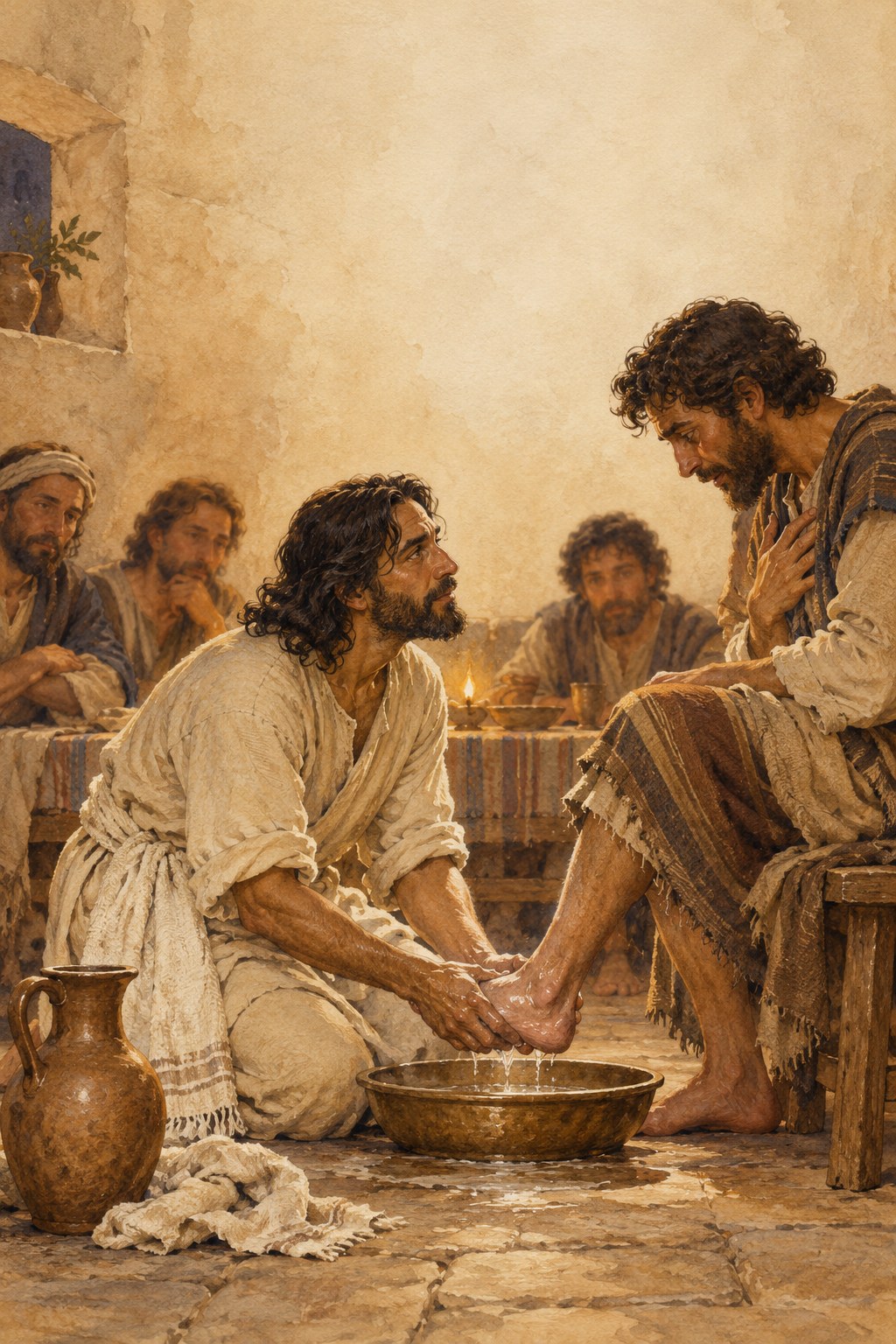
Jesus kneels beside a basin and gently washes a disciple’s feet as others watch
The Humble King · Example cover concept

04 / SECOND DEVELOPMENT SEASON

The Book
of the Son

The Maker enters the world He made.

Through the life of Jesus, The Book of the Son explores the character of God made visible: welcoming the overlooked, restoring dignity, calling people into relationship, and kneeling to wash His disciples’ feet.

Here, greatness takes the form of service. His love carries Him through the Cross and Resurrection, opening the way for us to become family and learn to walk with Him.

Creative work: A book, companion music, and illustrations.

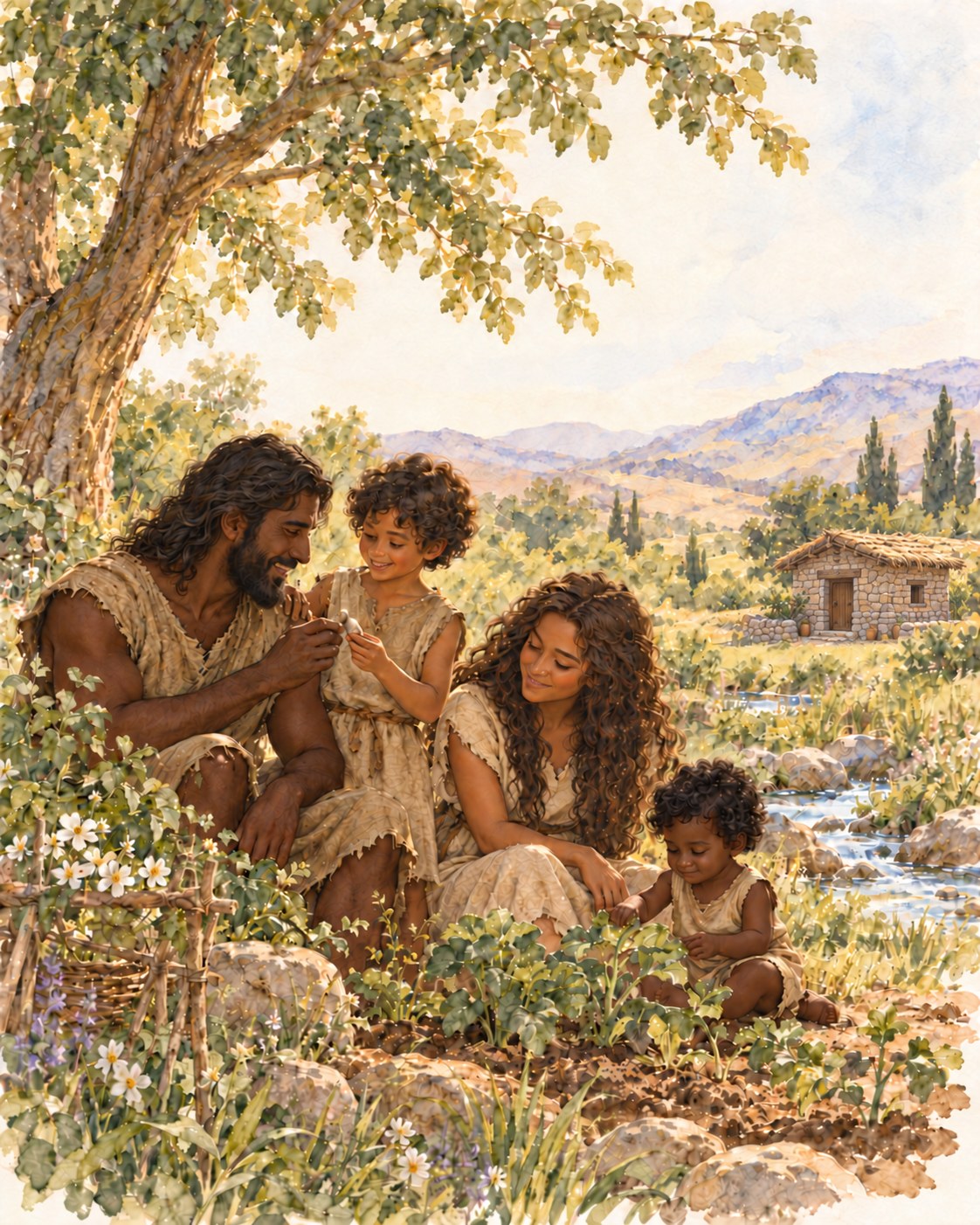
An imagined first family with two young boys beside a stream and a stone home
The first family · Example cover concept

05 / SECOND DEVELOPMENT SEASON

The Book
of Beginnings

A world received as a gift.

Before there were cities, kingdoms, or towers, there was a world received as a gift—and a family learning to live within it.

The Book of Beginnings follows the early human story from creation through Moses: beauty and belonging, freedom and fracture, and the faithfulness of the God who continues to call His people.

The example cover returns to the first family. It invites us to imagine the ordinary tenderness of life together within a creation that remains beautiful, even as the human story becomes difficult.

Creative work: A book, companion music, and illustrations.

BRING YOUR GIFTS INTO THE STORY

Art opens a door.
Partnership carries it forward.

An invitation to illustrators

We welcome conversations with Christian artists who would like to help bring these stories to life through hand-drawn and painted work.

The example images offer starting points. Artists are welcome to propose different scenes, compositions, and interpretations within each project’s biblical themes. We will discuss scope, permissions, credit, and compensation before work begins.

Discuss Illustration Opportunities

An invitation to supporters

Our immediate priority is A Song for the Generations. Your support can help bring its stories, songs, and illustrations into the lives of readers and listeners—and prepare the way for its first musical.

If this work speaks to you, I would welcome a conversation.

Support A Song for the Generations

Talk With Vidar →

Example illustrations are AI-assisted concepts, offered as invitations to human artists. Development dates are planning targets and may evolve.