
A room became a studio
Years ago, when I produced my first album, I wrote the lyrics and invited friends to help turn them into fully realized songs. Singers, musicians and recording brought their gifts to words that had begun in my imagination. For that season, I converted a room in our house into a studio.
It became one of the most joyful creative experiences of my life.
I loved hearing another person discover a possibility within a song: something I had hoped for but could not yet express, or something their artistry revealed that I would never have imagined. The work grew through that meeting of gifts, as words I had written became music we could make together.
Today, new technology allows me to bring a fuller beginning into that room. I can prepare a working demonstration that gives musicians something to hear, question and develop—a possible melody, an atmosphere, a movement toward what a song might become. Singers, instrumentalists, arrangers and producers can then bring their judgment and craft to the work, taking it further or discovering a different direction.
That is what I want these tools to make possible: more opportunities for people to create, more room for gifts to flourish, and a clearer invitation into work worth doing together.
The fire we tend
Long before recording studios or printing presses, people learned to tend a fire. Around its warmth, food could be prepared, darkness held back, and stories carried from one voice to another. Yet the same fire could consume the home it had helped sustain.
Human invention has always carried this double possibility.
Across the centuries, the printing press, the telephone, powered flight, electronic computers, the internet and mobile phones have extended our reach and changed our habits. Artificial intelligence brings another profound expansion of what people can accomplish, placing an ancient question before us with fresh urgency: what should our growing power serve?
Technology enters a world already marked by human generosity and human sin. It can help us heal, communicate, create and discover; it can also amplify deception, exploitation and violence. Its design matters, its ownership matters, and the purposes built into it matter.
For DAWN, the direction begins with a calling: to serve God’s kingdom, honor human dignity, and cultivate beauty, goodness and truth. We consider our tools in the light of that calling, grateful for their possibilities and honest about their dangers.
The dignity already given
Before anyone built a tower, wrote a song or shaped the materials of the earth, humanity had already received its dignity.
We were made in the image of God.
That gift belongs as fully to a child who has yet to speak as to an artist whose work moves thousands, and to an elderly person whose strength is fading as to an inventor opening an unfamiliar future. It does not depend upon intelligence, productivity, independence or technological ability.
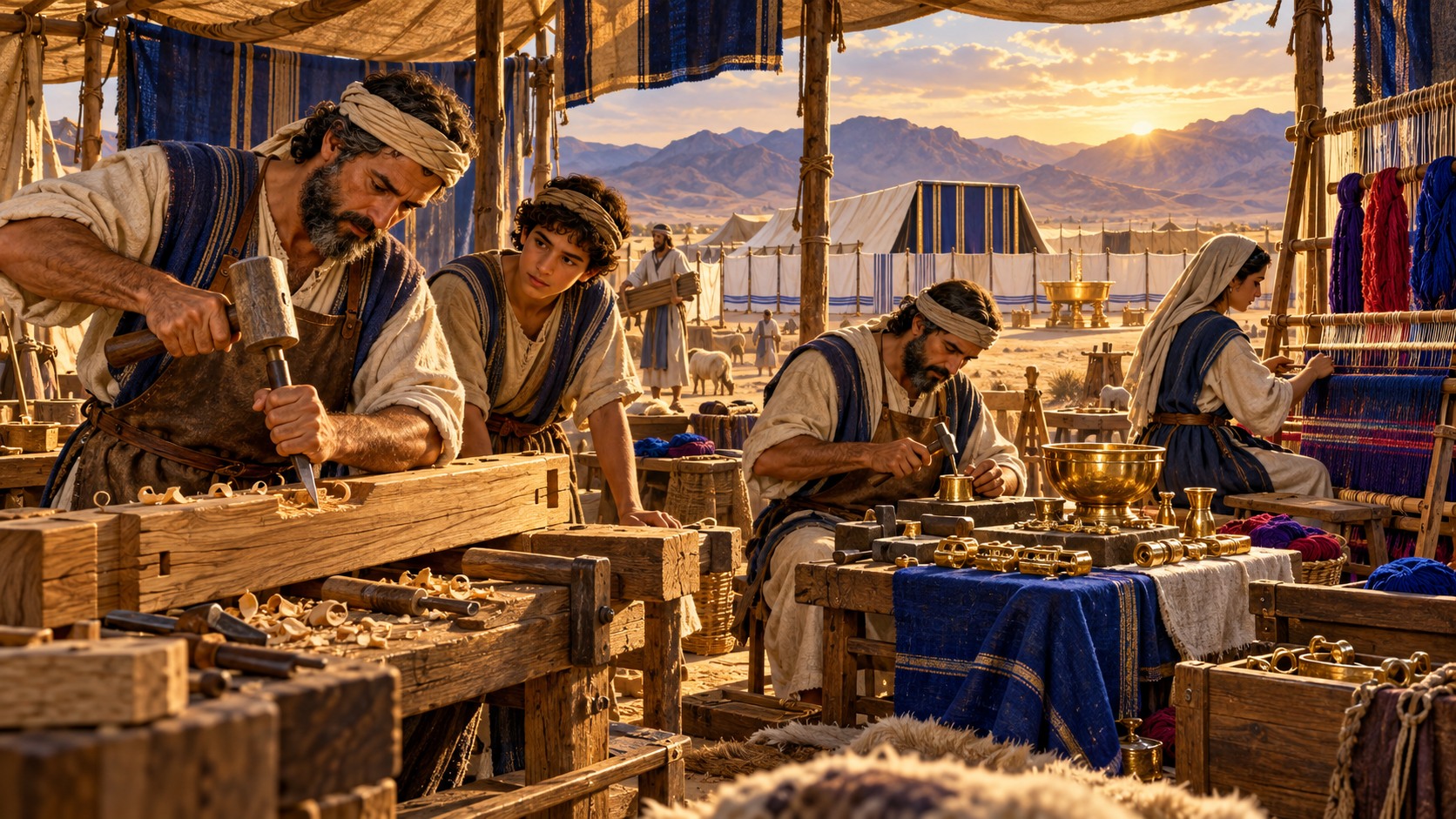
In Exodus, God calls artisans to the work of the tabernacle and equips them with wisdom, understanding and skill. Their craftsmanship becomes an offering: human hands responding to a divine invitation. Beauty belongs within faithful service, and skill becomes a gift to the community.
That vision helps us approach every new tool. Does it deepen our capacity to create, understand and care? What habits does it encourage? Whose dignity does it uphold, and whose freedom might it place at risk?
John Lennox’s reflections on artificial intelligence bring these questions into focus. He welcomes beneficial applications while warning about intrusive surveillance, attempts to redesign humanity, and technological promises of salvation that cannot address human sin. His concerns direct our attention beyond what a system can accomplish to the future we are seeking—and the power some people may acquire over others.
Three dangers deserve particular care.
When improvement becomes an attempt to remake humanity
A tool that restores a lost ability or sustains a life can be a profound expression of care. The deeper concern arises when the ambition moves toward redesigning human beings according to someone else’s vision of what humanity ought to become.
Some advocates of technological transformation imagine a future in which the boundaries between person and machine dissolve, human limitations are engineered away, and death itself is overcome. Within that promise, our created humanity can begin to appear as a defect awaiting correction.
We should take seriously the harm that could follow if people gained the power to impose such a vision upon others. What is presented as humanity’s advancement could destroy much that makes human life recognizable: embodied relationship, freedom, responsibility and the dignity of receiving life as a gift.
Christian faith addresses a wound deeper than technological limitation. Scripture places death within the tragedy of sin and a creation estranged from its Maker. However much medicine may relieve suffering or extend our years, no machine can reconcile us to God.
Our redemption rests in Jesus Christ: the Creator who came among us in human flesh, gave His life and shed His blood for us, and rose again. Everlasting life is His gift, secured through His victory over sin and death.
When convenience becomes control
Another danger begins with a familiar temptation: surrendering responsibility in exchange for the promise that someone else will keep us safe.
Powerful systems may offer greater convenience, security and efficiency. Yet the authority entrusted to them can also be used to watch, manipulate or restrict the people they were meant to serve. Beneath a promise of peace and progress, power can quietly gather into fewer hands.
We therefore need to ask who directs these systems, who can challenge their decisions, and what happens to the person who refuses to comply. Human beings must never become merely records to be sorted, behaviors to be managed, or obstacles to an efficient plan.
Freedom requires stewardship, as does power. Love of neighbor calls us to protect vulnerable people and preserve the space in which conscience, responsibility and meaningful choice can remain alive.
When assistance weakens the gifts it should serve
There is also a quieter danger, close to ordinary life.
We can become so accustomed to assistance that we cease practicing the abilities through which understanding and imagination grow. A tool may help us finish a task while leaving us less able to do it ourselves. If we continually surrender the difficult work of reading, writing, remembering, questioning or creating, convenience may gradually narrow the capacities it promised to enlarge.
This calls for attention to our habits. Does the tool invite us further into the work, or encourage us to remain outside it? Are we learning to see more clearly, or becoming satisfied with an answer we have never examined?
An artist still needs to observe, a writer to wrestle with meaning, and a musician to listen. In every calling, we need discernment.
We can welcome assistance while preserving the patient attention through which wisdom and skill take root.
When the press carried the song
We have encountered world-changing tools before.
In the fifteenth century, Gutenberg’s printing developments in Europe greatly expanded the possibilities of reproducing the written word. By the time of Luther and the Reformation, printers could carry arguments, Scripture and songs far beyond the reach of a single voice or manuscript.
The gospel had been proclaimed for centuries. During the Reformation, its message of grace received renewed emphasis and spread amid fierce religious and political conflict. Luther faced condemnation from both church and imperial authorities, yet print helped his writings travel beyond the places where he could safely stand.
The movement also sang.
Printed hymn sheets and hymnbooks carried biblical teaching in words and melodies people could remember and share. Scripture in the language of its readers reached homes and communities through repeated editions, no longer dependent upon the slow labor of copying every manuscript by hand.
The press placed the message of grace into more hands. Its power served a proclamation whose life came from God.
That history invites us to consider our own moment with courage. A tool capable of spreading falsehood can also carry a faithful witness. What will we make available through it, and with what truthfulness, imagination and love?
Make room for the artist
That history also asks something of the church today. In a culture weary with argument, confused about belonging and sometimes quick to anger, people can grow guarded against words before they have heard what those words might offer. A song, a poem or an image may reach them through a quieter door, awakening an attention that another argument could not command.
Beauty can invite us to pause. Goodness, encountered through a story or embodied in the person beside us, can make that invitation trustworthy. As attention becomes wonder and trust makes room for honest questions, truth may be heard with a new openness. We begin to recognize that our longing for love and belonging reaches beyond ourselves toward the Creator whose image we bear.
This is an approach to encounter, rather than a doctrine or a sequence every person must follow. Beauty, goodness and truth belong together; each can help us recognize the others. The artist’s calling is to offer something truthful and worthy of attention, honoring the freedom of the person who receives it. Through that gift, a listener or reader may glimpse God’s great romance for the world He made and the people He loves.
The artisans pictured at the beginning of this page remind us that such work has a place within the life of God’s people. Their imagination and skill helped give visible form to a sanctuary where the community would worship. At Jericho, too, sound had a place in the people’s obedience: seven priests sounded trumpets before the ark as Israel marched according to God’s command (Joshua 6:6–10). Their sounding accompanied a people moving together in trust; the victory belonged to God.
These scenes invite us to take artistic gifts seriously within our shared calling. The church at large—and all who care about human flourishing—can become more intentional about welcoming, cultivating and supporting artists. Encouragement matters, and so do opportunities to learn, time and space to practice, thoughtful commissions, fair compensation and communities willing to listen. A musician, poet, illustrator or craftsperson needs more than an occasional invitation to contribute; they need people who recognize the worth of the work and help sustain it.
As technology changes what can be made and how quickly it can circulate, this is a moment to deepen our commitment to human dignity and human artistry. We can place useful tools in the service of the imagination, skill and responsibility God has entrusted to people, helping their gifts mature and their work reach others.
The same calling that once gathered my friends into a room made into a studio can gather us again: to bring what we have, make room for one another, and offer a confused world something through which the love of its Maker may become more visible.
A grain of sand
Imagine gathering into a single machine every preserved discovery, calculation, manuscript and recorded conversation in human history. Suppose all of it could be summoned in an instant.
We might stand astonished before how much it held.
Then consider the infinite God.
Beside His inexhaustible understanding, the accumulated knowledge of humanity would be like a grain of sand upon the shore. Even that image falls short: the shore has boundaries, while His wisdom has none. Everything the machine contained would belong to the creation whose existence He sustains.
And the One beyond our measuring became flesh and dwelt among us.
God is neither surprised nor threatened by what His creatures discover. Our dangers are real and our decisions matter, but the future has not slipped from His hands. An old song carries a truth worth remembering: “He holds the whole world in His hands.”
That simple assurance has room enough for this complicated age.
His peace gives us room to think clearly, resist what diminishes life, and undertake the good before us. We can be watchful without surrendering to fear, and hopeful without becoming careless.
A beginning, and an invitation
This first DAWN website grew from a desire to make the vision visible within the time and resources available. I used AI tools to help build the site, generate its initial illustrations and prepare creative demonstrations that others could encounter and develop.
These images illustrate stories and themes; they are not photographs of actual DAWN gatherings or events. They give this beginning a visible form while opening a door to human collaboration.
I would love to welcome artists who recognize something of their own calling here. Perhaps an existing work belongs beside one of these stories. Perhaps a passage or song will awaken the desire to create something new.
For A Song for the Generations, we envision a book-cover illustration and sixteen hand-drawn chapter-opening images, each capturing something essential within its story. Accepted artwork will be used by agreement, with permission and clear credit, and with opportunities to introduce readers to the artist behind it.
My hope is that this beginning will become a meeting place for human gifts, much as that room in our home once became a studio.
Explore contributing artworkFully alive in the world God loves
We are called to be salt and light within the world we inhabit. That calling asks for engagement: the courage to enter difficult conversations, protect human dignity and freedom, cultivate beauty, and place our abilities in the service of our neighbors.
If Christians withdraw from the places where new tools are being shaped, those decisions will still be made. We have something worth bringing to them: a vision of the human person grounded in creation, a truthful account of our brokenness, and hope founded upon the love and victory of Jesus Christ.
Our moment is challenging and full of possibility. We can help shape how technology is used, carry the gospel into new places, and make room for people whose gifts might otherwise remain unseen. There is faithful work to do, and reason to undertake it with joy.
The King who came among us will return as He promised. Our hope reaches toward the day when God dwells with His people in a renewed creation, and the One who made us welcomes us Home.
Until then, there are stories to tell, songs to sing, skills to cultivate and neighbors to love. May the tools in our hands help that love take visible form.
We undertake this work in the assurance of His presence:
“I am with you always, to the end of the age.”
—Matthew 28:20
And we carry into this changing world the greeting of the risen Lord:
“Peace be with you.”
—John 20:19
Further reading: John Lennox on artificial intelligence and the future of humanity (paraphrased above); The Library of Congress on Luther and printing; Early Lutheran hymnbooks. Biblical foundations: Genesis 1:26–27; Exodus 35:30–35; Joshua 6:6–10; Matthew 5:13–16; John 1:14; Romans 5:12; 1 Corinthians 15:3–4; Revelation 21:1–5. Closing passages: Matthew 28:20 and John 20:19 (ESV).